

Ultrasonic sensors
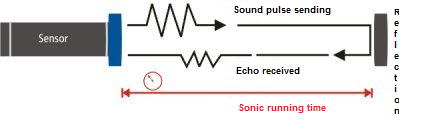
Dietz ultrasonic sensors operate on the principle of time-of-flight measurement of high-frequency sound pulses. The cyclically emitted pulses are reflected by the object being detected and return to the sensor as an echo (see also the figure below). The integrated electronics then calculate the distance to the object. This measuring principle enables the detection of a wide variety of objects, largely independent of color and surface texture, even under adverse environmental conditions such as contamination. Even crystal-clear objects or transparent films can be reliably detected.
Another advantage is that the sound beam can be deflected almost without loss via angled reflective surfaces. This can be particularly beneficial in confined installation spaces. Dietz ultrasonic sensors cover operating ranges from 0.02 to 8 m, and their high sound power allows for the reliable detection of very small and moving parts.
Regarding the detection range, it should be noted that sound attenuation depends primarily on air temperature, humidity, and air pressure. This can cause the nominal range to be exceeded or fallen short of. In simple terms, the higher the measured values of the air (e.g., temperature), the greater the attenuation, and vice versa.
Besides the fundamental distinction between switching and analog (measuring) ultrasonic sensors, a wide variety of features are available (e.g., teach-in, synchronization inputs, pulse extension). Some series can be configured almost entirely according to customer requirements. The ultrasonic principle complements other operating principles, such as that of optical sensors.
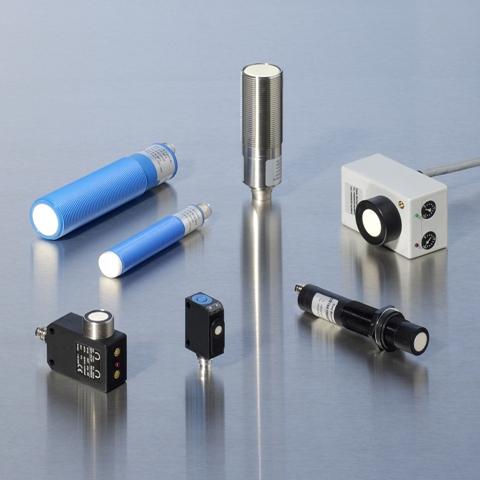
You can find more versions in the product finder
Types
- Digital versions, 1 or more adjustable switching points. Ranges up to 8000 mm
- Versions with analog output, 4-20mA and 0-10V (partially invertible). Ranges up to 6000 mm
- Ultrasonic barriers, no blind zone, increased measuring speed. Range 1500 mm
- Ultrasonic fork sensors, particularly suitable for use for web edge control
Product assortment
- Cylindrical and cuboid designs
- Analog or Digital Outputs
- radial or axial sound exit
- Teachable models
- Versions with pulse extension
- Versions with synchronization input
- Variants in stainless steel or teflon housing
- Surface-independent object detection
- High sound pressure to capture small objects
- Small blind area
Application examples
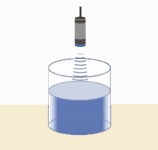
- Level control of liquids and granules
- Distance measurement and control
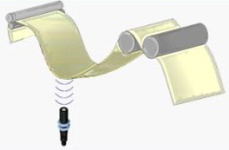
- Belt tension or sag control
- web edge control
- height scanning
- Min.-Max Control
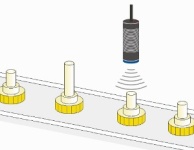
- Counting & Capturing Objects and People
More information Ultrasonic sensors
Ultrasonic sensors are among the all-rounder among the sensors and meet the requirements of most industrial detection tasks with the highest precision. Even the detection of transparent or high-gloss objects is no problem. In addition, there is a pronounced dirt tolerance and a high level of process reliability. You can find a large selection of powerful ultrasonic sensors in the range of Dietz Sensortechnik. Call now and together we will find the right models for your area of application.
How ultrasonic sensors work
Ultrasonic sensors detect distances according to the principle of running time measurement of high-frequency sound pulses. The pulses emitted cyclically spread out in the room at the speed of sound and are reflected when hitting objects. The resulting echo is detected by the sensor, whereupon the distance from the time difference between sending and receiving is calculated. For the correct functioning of the sensor, it is irrelevant whether the object is made of metal, wood or plastic.
Depending on the area of application, ultrasonic sensors in different versions are used. Above all, proximity switches, reflection switches, one-way barriers and distance sensors should be mentioned here.
Ultrasonic Proximity Switch:
A special sound transducer is used in this design, which enables the optional transmission and reception of sound waves. First, it sends out a certain number of waves reflected by the captured object. Immediately after that, he switches to receiving mode and determines the distance based on the time between emitting and receiving.
Reflective barriers:
The functional principle of reflection barriers essentially corresponds to that of proximity switches. The only difference is that the signal is returned by a special reflector. If an object moves between the transmitter and the reflector, the connection is interrupted and the sensor changes the signal at the switching output.
Ultrasonic disposable barriers:
For ultrasonic disposable barriers, transmitters and receivers are in two separate housings. With this technology, the transmitter permanently emits sound waves that are transmitted via the air to the receiver. If they are interrupted by an object, the receiver switches the output stage. The input signal gain can be precisely matched to the objects to be recognized via the potentiometer contained in the receiver.
Ultrasonic Distance Sensors:
In this design, the measured distance is given as a voltage value based on the pulse echo method. Its change is proportional to the removal of the captured object.
Advantages of ultrasonic sensors
In the industrial sector, ultrasonic sensors impress with their reliability and flexibility. When recording objects and filling levels, they also meet complex requirements, whereby they deliver the best results even under extreme conditions. Added to this are their robustness and their self-cleaning that is guaranteed by permanent vibration.
Another advantage is that the sound beam can be deflected almost without loss via oblique reflection surfaces. This can be particularly advantageous in cramped installation conditions.
At Dietz Sensortechnik you will find ultrasonic sensors for every application
For a long time, the ultrasonic measuring principle was primarily considered a solution for particularly complex measurement tasks. In addition, the technology was considered to be comparatively difficult to implement, especially in the initial phase. This has now changed. Today, ultrasonic sensor technology is used in almost all industrial areas and has proven itself completely. Typical fields of application are:
- Level control of liquids and granules
- Distance measurement and control
- Belt tension or sag control
- web edge control
- height scanning
- Min/Max Control
- Counting & Capturing Objects and People
As an expert in high-performance sensor technology, we have been supporting a wide range of customers from a wide variety of areas such as mechanical engineering, the food industry and the building materials, wood and furniture industry for over two decades. Benefit from our experience and find the perfect sensor solution for your needs with us.
Notes on choosing ultrasonic sensors
The pronounced versatility of the technology shows one thing clearly: There can be no universal sensor that covers all areas of application. Each area of application has its own requirements. Therefore, all sensor applications must be conscientiously configured and individually optimized. The following factors play a central role.
Measuring range:
Ultrasonic distance sensors are available for different measurement ranges. It should be noted that the sound attenuation is influenced by factors such as the air temperature, the humidity and the air pressure, which in turn can lead to an under- or exceeding the nominal ranges. Basically, with increasing measured values of the air, the damping also increases and vice versa.
Additional features:
In addition to the basic distinction between switching and measuring sensors, many additional equipment is available. The main features here are teach-in, synchronization inputs and pulse extensions.
Other relevant selection aspects:
- Cylinder or cuboid design
- Analog or digital output
- radial or axial sound exit
- Stainless steel or Teflon housing
- Surface-independent object detection
- Greater sound pressure to capture small objects
- size of the blind area
Feel free to call us
At Dietz Sensortechnik you will find a large selection of powerful ultrasonic sensors for every application area. Let us advise you now. We would be happy to help you with any questions.
FAQ
What is an ultrasonic sensor?
Ultrasonic sensors are, so to speak, all-rounders. They are suitable for almost all detection tasks in the industry. Your transmitter is constantly emitting sound waves. The waves reach the receiver through the air. If an object interrupts the sound waves, the receiver switches the output stage through.
Ultrasonic sensors detect objects in solid, granular, liquid or powdered form. In addition, they reliably recognize high-gloss objects, as well as color-changing and transparent ones. Dirt doesn’t bother them at all. Because the ultrasound penetrates it. Even smoke, dust or fog does not impede the ultrasonic sensor in its work.
What types of ultrasonic sensors are there?
A simple type is the ultrasonic proximity switches. In these models, the transmitter and receiver are housed in one and the same housing. The transmitter emits an ultrasonic signal. When this hits an object, it is reflected directly by that object and thus arrives at the recipient.
The reflection barrier works on the same principle as an ultrasonic proximity switch. But in contrast to the ultrasonic proximity switches, you need a reflector that reflects the signal. In principle, any stationary object can be used as a reflector that reflects sound. This can be, for example, a conveyor belt, a wall or something similar. If an object interrupts the distance between the sensor and this reflector, the sensor no longer recognizes the reflector. Then, for example, he triggers an alarm. or a machine is stopped.
In contrast, transmitters and receivers for ultrasonic disposable barriers are in two separate housings. These disposable barriers have long ranges and short response times. If an object passes the barrier and thus interrupts the sound waves, a switching operation is triggered by attenuating the signal in the receiver.
Ultrasonic fork sensors are in principle ultrasonic barriers in which the transmitter and receiver unit are opposite each other. Both are firmly mounted at the ends of a fork-shaped frame.