
Radar Sensors
Radar sensors are powerful motion detectors. Unlike optical sensors, which use infrared technology, they can not only detect an object, but also determine whether it is approaching or moving away from the sensor.
Radar sensors are used, for example, to control automatic gates. These sensors can even be installed in concealed locations, such as behind a plastic cover. Even if the sensor becomes dirty, it continues to function reliably because radar technology works through this material.
Radar sensors offer a number of advantages over conventional motion detectors:
- The switching function can be adjusted depending on the direction of movement.
- The detection sensitivity is adjustable.
- Concealed installation is possible, e.g. behind plastic covers.
- High resistance to soiling
- Short response times
- High protection rating IP 68
Our devices can be ordered as motion detectors and as barriers.
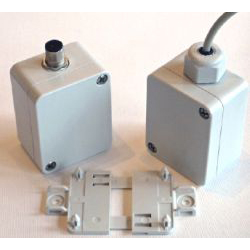
Further details can be found in the product finder.
Typical areas of application are
- Door and gate automation
- anteroom surveillance
- Monitoring of larger areas
- Access Control
Get information on Radar sensors
Radar sensors play a central role in factory automation, in the field of traffic engineering, building monitoring and automated lighting control. In daily use, the technology convinces above all with its reliability, its precision and its flexibility. A large selection of high-quality radar sensors can be found in the Dietz Sensortechnik range. If you have any questions about individual products, please call us and get advice.
How radar sensors work
Radar is the abbreviation for “Radio Detection and Ranging”, which freely translates to “radio-based location and distance measurement”.
A radar device emits several thousand bundled electromagnetic waves per second and analyzes them after being reflected and thrown back by surfaces. Since a specific time period elapses between sending and receiving, the distance, direction, angle of motion and radial speeds of reflective objects such as cars can be calculated based on the propagation delay and the Doppler frequency shift.
The line-up of the individual measurements results in the distance and the absolute speed of the recorded objects. If the resolution is high enough, even its contours can be registered.
Advantages of radar sensors
In contrast to optical sensors that work with infrared technology, radar sensors can not only register movement states in general. They also determine whether the detected object is closer to the sensor or moves away from it. There are also a number of other advantages:
- The switching function can be adjusted depending on the direction of movement
- The detection sensitivity is variable
- Concealed installation is possible, e.g. behind plastic covers
- High resistance to dirt
- Short response times
- High precision, since measurements can be carried out under temperature, pressure and dust development
The right radar sensor for every application
At Dietz Sensortechnik you will find a variety of radar sensors for a wide variety of applications. some examples.
Vehicle technology:
A prominent application of radar sensors are passenger cars. Here you monitor your environment by determining the distances to obstacles and their relative speeds. Functions typically adopted by radar sensors are lane change assistants, blind spot detection and parking support.
Automatic gates:
Radar sensors are also used when controlling automatic gates. A big advantage is that they can be installed concealed, e.g. behind plastic covers.
Contactless level measurement in industry:
In industry, radar sensors are used for non-contact level measurement, for example in storage silos. The emitted electromagnetic waves hit the filling material and are reflected by it. The received signals are processed, whereupon the control unit refills or emptys the silo when certain thresholds are reached.
Other areas of application:
- Monitoring of larger areas
- Access Control
- traffic control
- Automatic lighting control
- Hygiene switch for sanitary rooms
- Alarm and Security Applications
- building control technology
What to look for when choosing radar sensors
When selecting radar sensors, the range of the detected area is important on the one hand, and on the other hand, the evaluation options and the electrical transmission of generated signals. Information on the detection area can be found under the manufacturer’s information. This is maximum information. If the radar signal is impeded by window panes or branches, it usually penetrates, but loses its range.
You can see which electrical connection options are available for the various radar sensors from the product data sheets. In addition, you will find all further information you need for your selection there:
- transmission power
- beam angle
- temperature range
- protection class
- Input
Feel free to call us
Dietz Sensortechnik is your specialist for high-performance radar sensors for every area of application. With us you will find the right model for your needs. We would be happy to advise you comprehensively and help you with any questions.
FAQ
What is a radar?
Radar is the abbreviation for “Radio Detection and Ranging”. This means freely translated as “radio-based location and distance measurement”. This actually describes the most important functions of this technology, which prevailed in the mid-twentieth century. It’s really indispensable from today’s time. Because radar is used on land, on the water, in the air and in space. And last but not least in the everyday life of most people, even if they are often not even aware of it. As a rule, the radar sensor is used when dangers have to be detected and prevented in good time.
How does a radar sensor work?
A radar device emits bundled electromagnetic waves. This is called the primary signal. The moment this signal hits an object, it is reflected from its surface. This creates an echo. The signal changes direction because it is thrown back. This is called a secondary signal. The radar device now picks up this secondary signal again. Since time has passed between sending and receiving, information can be obtained from it. The distance of the reflecting object can be seen from this measured time period. This is how any radar system works.
What is a radar sensor used for?
Valuable information is obtained by measuring primary and secondary signals. Because it measures the distance of the object from the transmitter, a radar sensor can be used to measure distances. The parking assistants of modern cars, for example, work with this method. The more data is measured, the more information can be derived from it. Therefore, a radar sensor can also be used for precise position detection. For example, you can precisely determine the current location of large and moving objects such as trains. But positions are also recorded on construction sites or in car washes to prevent collisions of various objects.
What does a motion detector do?
A typical and everyday use of motion detectors are motion switches. For example, they automatically turn on the light when you perceive a movement. For example, when people enter a certain room. But if nothing moves, the light stays off. As a result, a lot of energy can be saved with long-term planning, both in the private household and in the commercial sector. Or the switch triggered by the radar sensor opens an automatic door. For example from shops or from public buildings. Then the technology ensures greater convenience and, last but not least, accessibility.
What is the difference to infrared technology?
The use of motion detectors in the field of safety is just as commonplace. A motion detector can provide automatic access and access control. Because he recognizes independently when a person or a vehicle passes a certain area. Basically, there are motion detectors with infrared technology and those with radar technology. The advantage of the radar sensors is that you can also determine in which direction certain objects are moving. Therefore, they are often used to control gate systems.
What are the advantages of Dietz radar sensors?
The detection sensitivity of the Dietz radar sensors is precisely adjustable. In this way, disturbing signals can be hidden, for example the movements of passers-by or trees in the wind. Our sensors are very resistant to dirt, even if they are strong. Therefore, they also serve very well in outdoor areas. The switching time of our radar sensors can be adjusted individually. It determines when the device responds after detecting an object. The assembly of Dietz motion detectors is generally easy. They can be mounted horizontally or vertically, depending on which measuring range is required.
What should you consider when setting up radar sensors?
There are very different models of motion detectors. They each do very specific tasks. The installation of the sensors depends very much on the specific purpose. Therefore, the individual circumstances and requirements on site must be precisely determined before assembly begins. Basically, if a radar motion detector is mounted indoors, it should not be in the immediate vicinity of fluorescent lamps. Because the complete sensitivity cannot be used there.