
Inductive Sensors
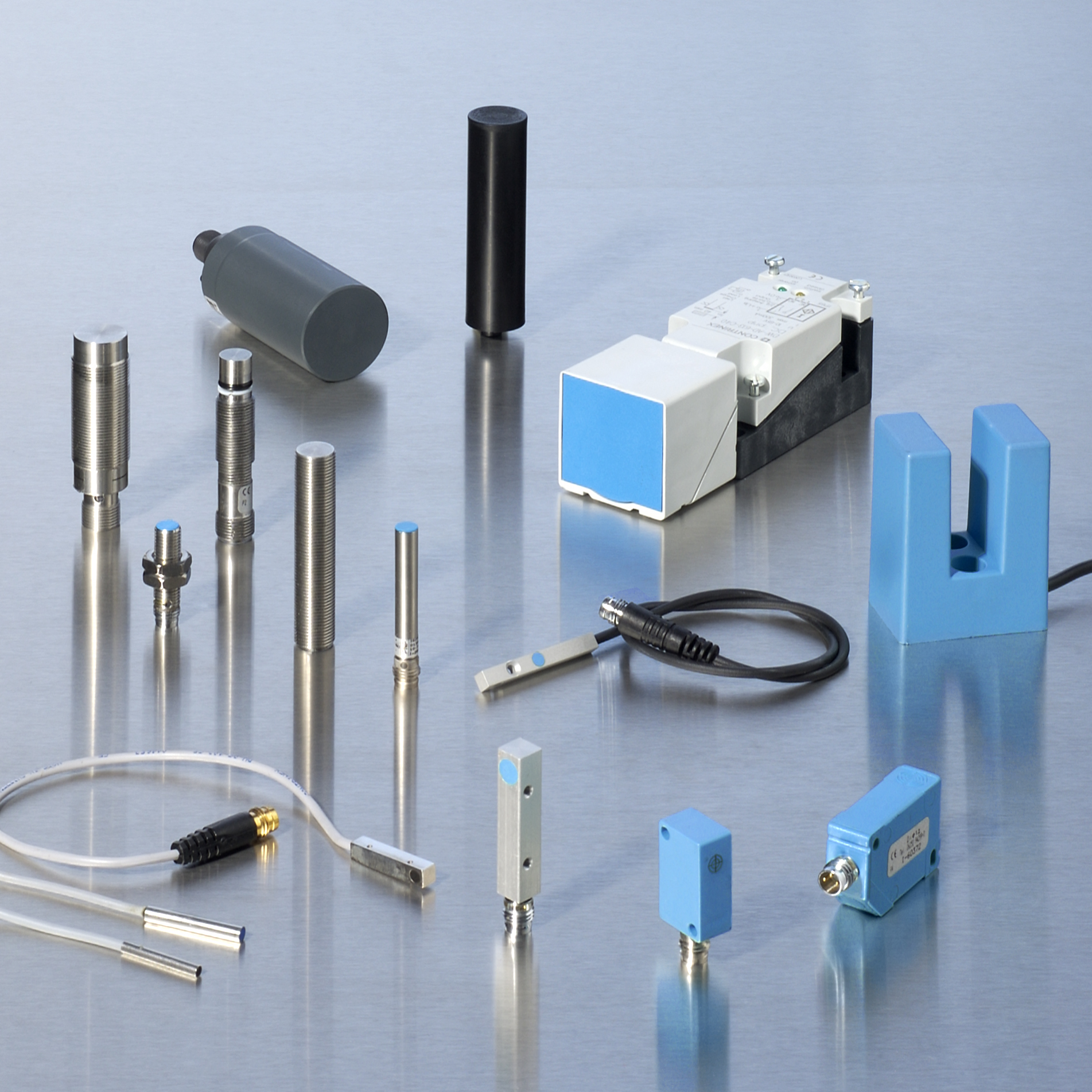
Inductive proximity switches are touchless and contactless limit switches, and therefore wear-free. They are activated by metallic objects brought close to the active surface of the sensors.
An inductive proximity switch consists of a high-frequency oscillator, a flip-flop, and a subsequent amplifier. The oscillator generates a high-frequency alternating field across the active part of the sensor. When an electrically conductive material (e.g., steel, copper, aluminum, graphite) is placed in this field, eddy currents form in the material, drawing energy from the oscillator. The oscillator voltage drops, and the flip-flop induces a change in the output switching state.
You can find more versions in the product finder
Dietz proximity switches are available in a variety of different designs and materials, with switching distances of up to 250 mm, as 2-, 3- or 4-wire, in DC and AC versions, with switching or analog outputs. They are used in a wide variety of industrial sectors in standard applications as well as in special applications that place the highest demands on robustness and functional reliability. Even where there is hardly any other solution to be found with conventional switches.
Inductive High and Low Temperature Sensors
Conventional inductive sensors are designed to ambient temperatures of only -25 °C to +70 °C due to design. The service life already suffers during operation in the limit areas, and perfect function is no longer guaranteed if the limit temperature is exceeded. This is where the area of application begins High Temperature Sensors and low-temperature sensors from Dietz.
Depending on the series, the use of special components and materials enables permanent ambient temperatures of up to +180 °C for devices with integrated evaluation and up to +300 °C for devices with a separate cable amplifier. Due to the largely modular design of these devices, e.g., the length, cable length or cable material can be varied if necessary. M5 up to M80 designs in combination with switching distances of up to 50 mm offer a wide range of applications. Typical areas of application can be found in the smelter and glass industry, in steel and rolling mills or in autoclaves.
Depending on the version, the low-temperature sensors are suitable for use at up to -100 °C and are therefore particularly suitable for use in cold stores and for special applications in the food industry.
Product Spectrum
Particularities
- Cylindrical from Ø 3 mm
- cuboid designs from 5×5 mm
- Short and miniature designs
- switching and analog outputs
- DC, AC and all-voltage
- 2-, 3- and 4-wire
- All Metal Versions
- Pressure-proof proximity switches up to 1000 bar (14,500 psi)
- High temperature switches up to +400 °C (752 °F)
- Deep temperature switches up to –60 °C (-76 °F)
- Versions with up to quadruple sensing distance
- Weld and magnetic field immune proximity switches
- Inductive ring sensors
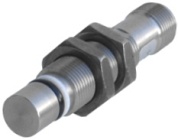
More information inductive sensors
The use of sensors as an information provider is a central prerequisite for the smooth running of automated production processes. By passing on precise information about the filling levels, component positions and machine end positions, they form the basis for the system control and allow permanent control.
At Dietz Sensortechnik you will find a large selection of high-quality inductive sensors that have been specially developed for the high loads in the industrial sector.
How inductive sensors work
Inductive sensors are position sensors with which metal parts and machine components made of metal can be accurately detected on the path of electromagnetic induction.
Its most important components include an oscillator and an LC resonant circuit. The oscillator generates a high-frequency alternating electromagnetic field via the oscillating circuit that exits the active sensor surface and generates eddy currents in each approaching electrically conductive object. These in turn lead to attenuation of the oscillating circuit and a change in level at the oscillator output. If it is a switching sensor, it activates the output stage if a defined threshold value is exceeded using the Schmitt trigger. Measuring sensors influence the analog output signal depending on the object distance.
Advantages of inductive sensors
Inductive sensors are characterized by specific advantages that underline their suitability for a wide range of different applications.
- Objects to be scanned are not hindered in their movement
- Short response and switching times
- No lifetime limitation due to number of switching cycles
- No failure due to dirty or corroded contacts
- No calculation of the approach curve required
- Only one design for different movements
- Very small designs can be realized
The right inductive sensor for every application
As an expert in induction sensors, Dietz Sensortechnik is responsible for market leaders from a wide variety of industries. Thanks to the know-how that we have built up, we are able to ensure an optimal result at all times when processing your orders.
A central application of our induction sensors is CNC technology. Here, inductive proximity switches are used, among other things, as limit switches, which react to electrically conductive materials even when approaching. This allows contactless and wear-free detection of end positions of moving machine parts.
In addition, there are numerous other areas in which induction sensors make an important contribution:
- Vehicle detection on roads
- metal detectors
- traffic light circuits
- End position detection hydraulic cylinder
What should be considered when choosing induction sensors?
When choosing inductive sensors, various factors must be taken into account. The following deserve special attention.
Switching distance:
Which sensor is suitable for the respective area of application depends to a large extent on the switching distance. It is defined as the distance between the sensor surface and the object to be monitored. The coil diameter and the material and the size of the object have a significant influence on the switching distance. As a basic rule, it can be stated: the larger the area, the greater the switching distance. Depending on the shape and size of the sensor, it is between 0.5 and 50 mm.
Temperature and pressure resistance:
Depending on the combination of materials, induction sensors can also withstand complex stresses while delivering precise results. Combinations of stainless steel and PTFE, for example, enable use under extreme temperature conditions such as in climate cabinets, outdoor applications and in paper machines. They also have a pronounced chemical resistance.
In this context, the degree of protection, which indicates the resistance to moisture and solids, is also important. If, for example, an induction sensor has IP68/69 protection, it can be cleaned with high-pressure devices and permanently used under pressure conditions of 16 bar.
Get in touch
If you are looking for high-quality induction sensors for a variety of applications, Dietz Sensortechnik is the right contact for you. With more than 20 years of experience in the field of sensor manufacturing, we offer you exactly the solutions you need for your project. Let us advise you now.
FAQ
What are inductive sensors?
The inductive sensors are among the proximity sensors which are also referred to as proximity switches. Proximity sensors are active devices that react non-contact to the approach of certain materials or objects. Due to their versatility, they come as subspecies of distance sensors used in a wide variety of industries. Basically, inductive sensors work with an inductance, i.e. an open coil. The coil emits a magnetic field. The actuation takes place when metallic objects are brought near the active area of the sensors.
Where are proximity sensors used?
In industrial production, inductive sensors determine the position of machines, parts or shafts. Proximity switches are therefore used in the context of quality assurance as well as for material testing.
What is a Schmitt trigger?
If an electrically conductive material enters the high-frequency alternating field, eddy currents arise in this material. The oscillator voltage then decreases and the downstream Schmitt trigger causes a change of the output switching state.
The Schmitt trigger is a comparator circuit named after its inventor Otto Schmitt, which is used to generate binary signals. On and off shafts do not coincide here. They are set against each other by a certain voltage: the switching hysteresis. At a certain input voltage, the circuit jumps from the resting to the working state. Two transistors share an emitter resistor. A transistor conducts and thereby holds the second disabled. Only at the moment a fixed input voltage is exceeded can the disabled transistor become conductive. At the same time, the rapid voltage rise ensures that the previously conducting transistor is now disabled. Depending on the design, the switching hysteresis can be a few millivolts or even go beyond the value of the supply voltage.
What connections are there?
In general, there are two types of connection for the inductive sensors. In the first form, the switches are connected by a cable with an open end. The second variant uses a plug connection. The latter offers an advantage: the switches can be easily replaced. In addition, the initial assembly is much easier. On the other hand, cable connections are less susceptible to sources of error such as a leaky plug connection.
Which outputs are used?
Generally, NPN or PNP outputs are used. PNP sensors are the standard in Europe, while NPN is the standard in Asia. The difference between the two circuits is simple: with PNP, “plus” is the switching wire, but with NPN “zero”.
What types of installation are there?
With regard to the types of installation, a distinction is made between two types: the flush and the non-flush switches. In this context, flush-mounted means that the fully assembled device finishes smoothly with the surrounding surface. In contrast, with a non-flush design, there is a free space on the side of the active surface. This free space is specified by Directive EN 60947-5-2. There are also the “quasi flush” switches. The latter also need a free space on the sides. But this only moves in the millimeter range.
What are free zones?
The so-called free zones are those areas around the sensor that have to be kept free of metallic materials during operation. Only then can the device work. In the case of inductive sensors, it is necessary to keep a total distance that does not fall below three times the nominal switching distance. When installing sensors that are not flush-mounted, it must also be noted that no disturbing material must be present at a distance corresponding to the diameter of the detection surface.